Source: OpenAI's official release page.
The official update: all three models at a glance
The naming: 5.6 is the generation, Sol / Terra / Luna are the capability tiers, ordered like the sun, the earth and the moon, each one lighter than the last. Here is how OpenAI positions them, with the original wording:
The smartest of the three. OpenAI points it at the four hardest kinds of work: coding, knowledge work (research, analysis, reports, anything that needs thinking pulled together), cybersecurity and science. Its strength is depth. Give it a problem that has to be broken apart, reasoned through and run over many steps, and it holds the thread instead of getting lost halfway. If you pay for Plus or Pro, the GPT-5.6 in your model menu is this one. You got the flagship with no setup needed.
"our flagship model for the hardest tasks, with leading performance across coding, knowledge work, cybersecurity, and science."
The balance point between speed and brains, positioned as the workhorse for everyday production work. The line that matters: it performs at the level of last year's flagship GPT-5.5, at half the cost. The smarts you had to pay flagship prices for last year now sit at mid-tier pricing. For most people, Terra covers nine out of ten daily jobs: questions, writing, tidying up information. Free and Go users get it inside ChatGPT Work and Codex, and in early August OpenAI went further and made Luna text chat unlimited for free and Go users.
"our balanced model for everyday production workloads, with GPT-5.5-level performance at lower cost."
The fastest and cheapest one, built for well-defined, high-volume work: sorting a thousand emails a day, batch translation, summaries in a fixed format. Repetitive jobs that need no deep thinking but come in bulk. It is not the one you have long conversations with, it is the one on the production line. The people who gain most are those building with the API and running automations: $0.2 per million input tokens and $1.2 per million output, cheap enough to leave running all day.
One more note: on 8/10 OpenAI also released GPT-5.6-Cyber, a security-focused model open only to vetted enterprises (the IBM and PwC tier). Regular users cannot touch it, so no need to hunt for a switch when you see the news.
"our fastest and most affordable model for well-defined, high-volume work."
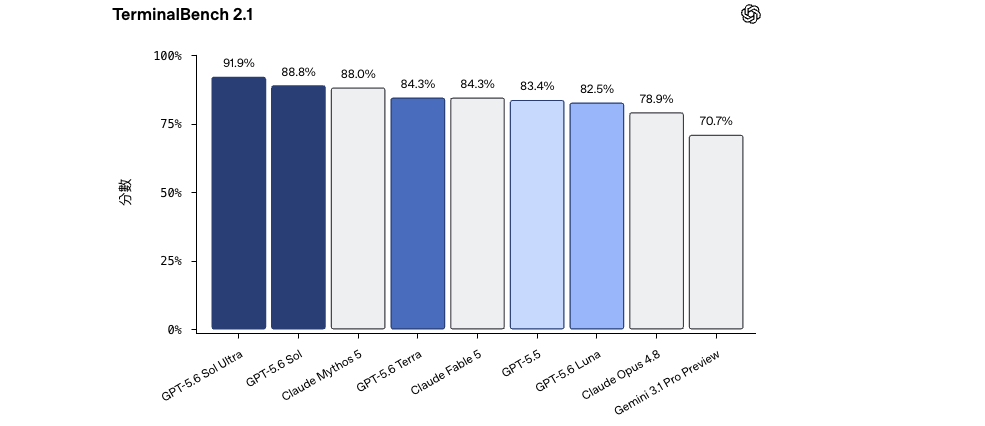
The charts: where it actually got better
Beginners: get it in 3 minutes
1. Which model did you get?
- Paid (Plus / Pro): open ChatGPT, and if the model menu shows "GPT-5.6 Sol", your upgrade is done
- Free: you run Terra inside ChatGPT Work and Codex, while the normal chat box stays as it was for now
2. How to use it, in one line
- Questions and writing → the default is fine
- Complex analysis, long documents → switch to Sol by hand and drop the whole file in (1M context, it swallows a book)
For heavy users
- How to pick a model: ask how smart this job really needs to be. Terra covers daily work, so do not burn Sol on what Terra can do
- Long agent runs are the big upgrade this round: hand over one whole job and let it run to the end before reporting back, instead of feeding it small steps
- The API price drop: Terra is $2 per 1M input tokens (half of the previous flagship) and Luna is $0.20, so the cost model for heavy automation needs a full recount
- An honest note: on complex coding tasks, independent reviews (Simon Willison) say it has not passed Claude yet (SWE-Bench Pro: Claude 80 vs Sol 64.6, a benchmark OpenAI disputes). My own split: GPT-5.6 for long agent runs, Claude for coding
- Specs: all three models have 1M context, 128K output, and knowledge up to Feb 2026
The three models side by side (save this one)
| Model | Who it fits | Strength | API price* |
|---|---|---|---|
| Sol | Paid users, heavy users | Long agent runs, strongest reasoning | $4 / $20 |
| Terra | Free users, everyday work | Close to last gen's performance at half the price | $2 / $12 |
| Luna | Developers, heavy automation | Fastest and cheapest | $0.20 / $1.20 |
Want to go deeper? My other pages
Want to learn AI with other people?
Join my free LINE learning community. Hands-on sharing, questions and answers, plus the tools and resources I keep dropping in
Join the Leo AI learning community →